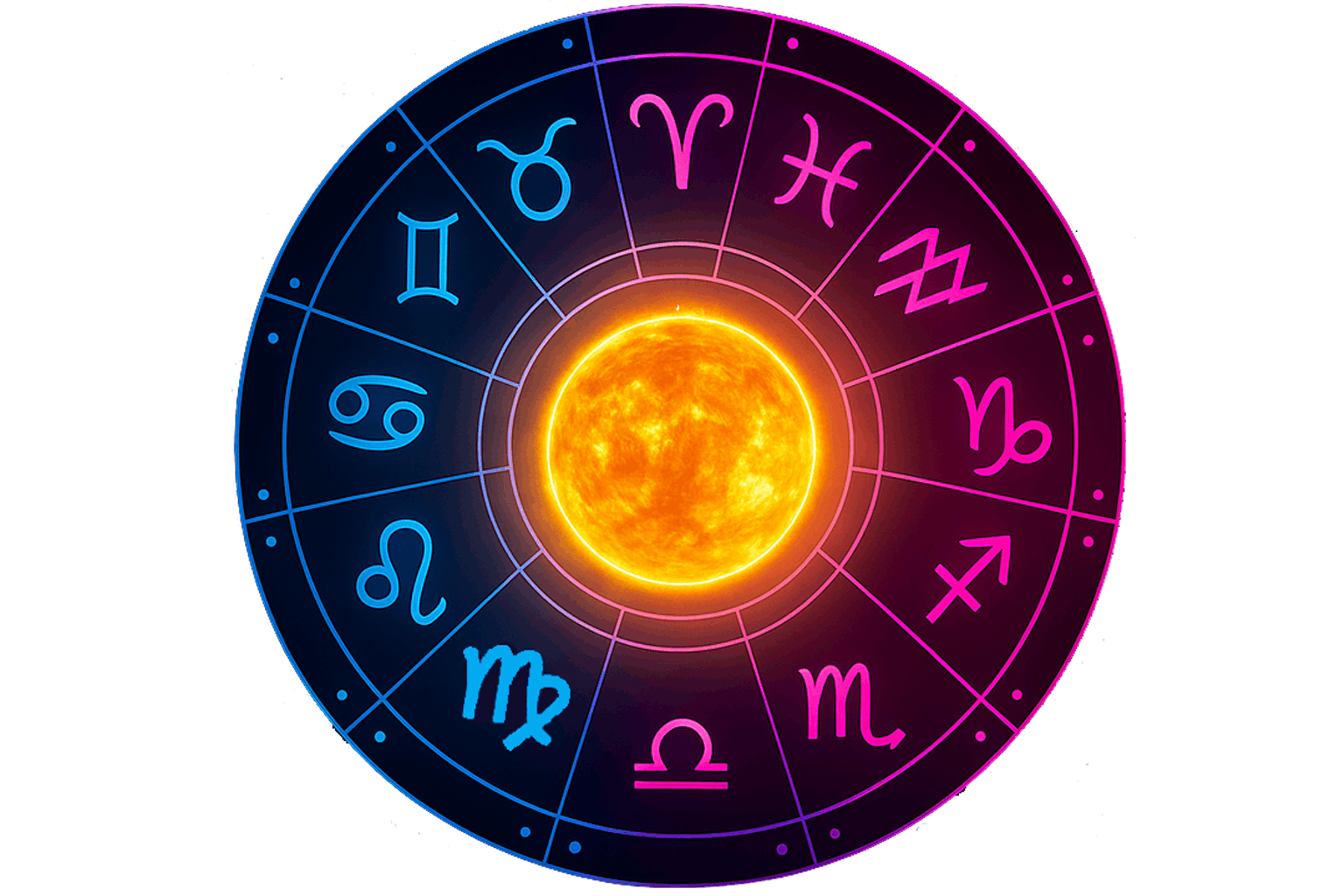
BIRTH CHART
A birth chart is based on the positions of the Sun, Moon, and planets at the time and place of your birth. It offers a more complete picture than a Sun sign horoscope because it considers several planetary placements together. Your personalized report uses your birth details to explain the main features of your natal chart through traditional Western astrology.

Enter Your Birth Details
What Does Your Birth Chart Reveal?
Every birth chart has its own arrangement of planets and zodiac signs. The Sun represents the central themes of identity and self-expression, while the Moon is associated with emotional responses and personal needs. Mercury relates to communication and thinking, Venus to affection and preferences, and Mars to action and motivation.
The other planets add further detail. Jupiter is traditionally associated with learning and expansion, Saturn with responsibility and discipline, while Uranus, Neptune, and Pluto are connected with wider themes of change and transformation. The meaning of each placement depends on its position in the chart and its relationship with other planets. You can learn more about these planetary symbols in our guide to the planets in astrology.
Your Sun, Moon, and Rising Sign
These three placements are often the starting point for understanding a natal chart. Your Sun sign describes the zodiac sign occupied by the Sun at birth. Your Moon sign is determined by the Moon's position and is traditionally interpreted in connection with feelings and instinctive reactions. The Rising Sign, or Ascendant, is the zodiac sign appearing on the eastern horizon at your birth.
Each has a different role in astrological interpretation. For example, someone may have a practical Sun sign, an emotionally expressive Moon sign, and a more reserved Rising Sign. Looking at them together gives a fuller picture than relying on the Sun sign alone.
Why Your Birth Time and Place Matter
Your date of birth helps establish the planetary positions, but your birth time and birthplace are needed to calculate the Ascendant and the twelve houses. The houses divide the chart into areas traditionally associated with subjects such as home, work, relationships, resources, and personal interests.
Even a difference in birth time can affect the Ascendant and house placements. Your birthplace also matters because the calculation uses geographical coordinates and the local time zone. Providing accurate details helps produce a chart that more closely reflects the sky at the time of your birth.
If you do not know your exact birth time, 12:00 PM (noon) can be entered as an approximate default. It should not be treated as your actual birth time. The Ascendant and house placements calculated from it may not reflect your natal chart accurately.
How the Different Parts of a Chart Work Together
A planet's zodiac sign is only one part of its interpretation. Its house position and the angles it forms with other planets also provide context. These angles are known as aspects. For example, two people may have Venus in the same zodiac sign but have different house placements and planetary aspects, resulting in different chart interpretations.
This is why a complete birth chart is not simply a collection of individual sign descriptions. The placements are considered together to understand the overall structure of the chart and the traditional meanings associated with it.
What Is Included in Your Birth Chart Report?
Your personalized report brings together the relevant details of your natal chart and explains them in an organized way. It is intended to help you understand how astrologers traditionally interpret different parts of a birth chart, including:
- Your major planetary placements and their zodiac signs.
- The Sun, Moon, and Ascendant in your natal chart.
- Planetary influences associated with communication, affection, and motivation.
- Relevant house placements and their traditional meanings.
- Connections between planets and the themes they represent.
- Personal, relationship, and career-related themes interpreted from the chart.
Astrology is a traditional belief system, not a scientific method of measuring personality or predicting someone's future. The report presents astrological interpretations for information and personal interest.